Prince Gives Harrison’s Rock Hall Tribute a Lyrical Guitar Centerpiece
Prince’s solo changes the center of attention during the Rock and Roll Hall of Fame tribute performance of While My Guitar Gently Weeps. Before the guitar moves forward, a group of musicians has already established the song’s setting. That preparation matters, giving the individual contribution a place within a collaboration rather than presenting it as a detached feature.
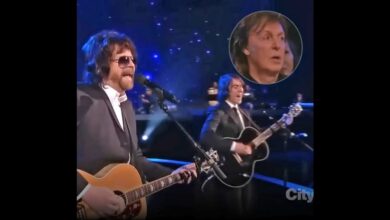
Tom Petty, Jeff Lynne, Steve Winwood, and Dhani Harrison are among the performers gathered around Harrison’s composition. Their vocal and instrumental roles supply the foundation in which the solo develops. The names help identify the occasion, but their musical contributions also give the guitar a recognizable pace, harmony, and mood to work with.
Prince enters the foreground without removing the song’s direction. The shift enlarges a performance already underway, allowing the solo to become a development of the tribute. Its arrival has dramatic force partly because listeners have a clear musical reference, making the new emphasis apparent within the established arrangement.
The phrasing uses contrast as a resource. Sustained notes create space, melodic lines continue a thought, and quicker passages alter its pace. Those relationships give the solo more than one expressive scale, allowing speed to have meaning through what surrounds it rather than becoming the only feature worth noticing.
The ending is a conspicuous part of the recording, but its effect has been prepared. Hearing the full solo reveals how tension gathers before the final gestures, giving them a musical context. The passage works across its development, making the route toward the conclusion as useful to follow as the image that closes it.
Watch the performance
Harrison’s harmony supplies room for an expressive lead. A phrase can continue over changing chords and acquire another weight as the accompaniment moves, creating possibilities for response inside the song. Prince’s line remains connected with that motion, giving the solo a foundation that can support both restraint and expansion.
Changes of attack add another kind of variety. A softer, more vocal-like tone and a sharper entrance can give similar notes different characters, allowing the instrument to suggest reflection or urgency. The listener follows those shifts within a continuing line, with control making the contrast clear rather than fragmenting the passage.
The band remains essential as the lead becomes more adventurous. A steady harmonic and rhythmic frame gives the guitar a place to stretch, creating room for tension while preserving a sense of direction. The shared arrangement supports the solo’s freedom, keeping the individual statement connected to the piece around it.
Watching the other musicians helps retain that larger picture. Their involvement makes the stage feel like an ensemble even when one player commands attention. The responses and continuing parts show how an unmistakably individual contribution can also be part of a shared offering to the songwriter being honored.
Theatrical movement belongs to the performance’s presentation, but the musical line supplies its continuing substance. A gesture can punctuate a phrase while the sound gives listeners something to follow afterward. Hearing and seeing those elements together keeps the stage action connected to the interpretation rather than allowing it to explain the whole effect alone.
A tribute can honor a composition by making another possibility audible within it. The writing remains recognizable while a performer changes its immediate focus, giving respect a form beyond exact reproduction. Here, the solo provides a clear personality inside a song whose familiar structure continues supporting the encounter.
That contrast works in both directions. The recognizable piece gives Prince’s choices a point of reference, and his phrasing draws new attention to what the arrangement can accommodate. Listeners can follow the melody and harmony while hearing a lead voice that belongs to this performance, making familiarity and individual expression mutually useful.
Revisiting the opening after the solo reveals the ensemble’s part in the build. The early mood gives the guitar something to enlarge, keeping the performance from depending on one musician to generate all its atmosphere at once. The solo gains a dramatic starting point through work that happens before it becomes central.
The recording supports detailed listening and immediate enjoyment at the same time. It is possible to follow the rise in intensity and return of musical ideas without naming every technique. Pacing and phrasing communicate a direction directly, allowing the stage moment to remain accessible while closer attention reveals more of its construction.
Hearing the guitar as another voice makes the appeal particularly clear. A held note can carry the weight of a sustained sung line, while a quick run changes the pace of an answer. Prince uses both within the accompaniment’s direction, giving the solo breadth without separating it from the song.
The solo remains compelling through personality given musical shape. Its beginning, changes, and release belong to a larger tribute, with the ensemble providing continuity around an individual statement. The theatrical conclusion is memorable, but the phrased line leading toward it gives the recording a strong reason to be heard again in full.
More performances to enjoy
Paul McCartney and Eric Clapton’s Something at the Concert for George offers another shared interpretation of Harrison’s writing. Its different vocal and instrumental frame provides a companion for considering how fellow musicians make a tribute through the composition itself.
Paul Simon, David Crosby, and Graham Nash performing Here Comes the Sun at the Rock and Roll Hall of Fame anniversary concert supplies another Harrison song in a live gathering. The vocal partnership changes the scale, offering a contrasting form of musical acknowledgment.