Aretha Franklin Sings ‘Nessun Dorma’ at the 1998 GRAMMYs
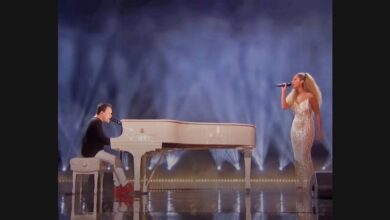
Aretha Franklin’s ‘Nessun Dorma’ at the 1998 GRAMMY Awards began with a last-minute change. Luciano Pavarotti was unable to perform, and Franklin took his place, bringing her own musical identity to a piece associated with opera.
The repertoire makes the substitution notable. Franklin was widely connected with soul, gospel and popular song, while ‘Nessun Dorma’ belongs to Giacomo Puccini’s opera ‘Turandot.’ The appearance invites listeners to hear beyond familiar genre boundaries.
The aria’s melody builds toward a broad, sustained statement. Its familiarity does not make it simple to perform: the musical line needs room to develop, and the dramatic direction must remain clear across the progression.
Franklin approaches the structure as herself. The recording is compelling as an interpretation by a distinctive singer, not as an attempt to make her interchangeable with the tenor who had been scheduled to appear.
The orchestra provides a frame for the vocal line. Its movement carries the aria forward, while Franklin’s phrasing gives the music an individual expressive center. Hearing those parts in relation helps clarify the performance’s shape.
Watch the performance
The substitution story creates immediate curiosity, but the circumstances are only the beginning. The musical interest lasts beyond the surprise because Franklin has to sustain the aria through its unfolding phrases and live setting.
Her voice can serve as a familiar point of entry for listeners who do not often choose opera. That recognition may encourage them to stay with the composition and explore a repertoire that feels less familiar at first.
The performance also illustrates the limits of genre labels. Categories can describe an artist’s usual repertoire, but they cannot predict everything that a singer might communicate when offered a different musical setting.
The full television clip lets the aria’s dramatic arc develop. The opening and its later expansion work together, so the performance is easier to understand in sequence than through a short excerpt of its most famous passage.
Listeners can follow the exchange between orchestral motion and Franklin’s sustained phrases. The accompaniment sets the musical direction, and her delivery gives those lines a particular expressive character within the larger structure.
Pavarotti’s live ‘Nessun Dorma’ is a natural companion recording. It places the aria in the tenor tradition strongly associated with it and allows a comparison that preserves the distinct choices each performer makes.
Franklin’s official audio recording offers another way to revisit her interpretation outside the awards broadcast. The audio shifts attention from the television staging to the musical line and the singer’s delivery.
Retellings of this appearance sometimes add increasingly specific claims about how long Franklin had to prepare or how large the audience was. Those details are not needed to understand the documented circumstance: the planned performer changed, and she accepted the role.
Accepting a live-broadcast substitution carries a particular responsibility. Once the music starts, the performer must shape a convincing sequence within the existing time and arrangement, without the option to pause and reconsider.
The recording encourages listeners to appreciate Franklin’s expressive personality while also becoming curious about Puccini’s opera and Pavarotti’s interpretation. One performance can create a meeting point between musical traditions.
Franklin’s 1998 appearance remains distinctive because the substitution led to a performance with its own character. The circumstances brought her to the aria; her musicianship gives viewers a reason to return to the clip.
More performances to enjoy
Aretha Franklin’s official ‘Nessun Dorma’ audio accompanies the GRAMMY footage. It offers another chance to hear her treatment of the composition without the surrounding television presentation.
Luciano Pavarotti performs ‘Nessun Dorma’ in an official live recording. His version provides an operatic point of comparison while leaving Franklin’s different vocal approach intact.
The broadcast and companion recordings provide further listening context for Franklin’s performance.