Andrea Bocelli and Teddy Swims Sing ‘Amazing Grace’ in St. Peter’s Square
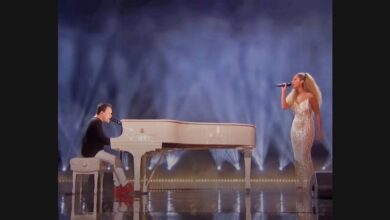
Andrea Bocelli and Teddy Swims perform “Amazing Grace” in St. Peter’s Square during Grace for the World, a Vatican City concert connected with the 2025 Jubilee Year and the World Meeting on Human Fraternity. The performance brings a familiar hymn into a public occasion, with two singers from different musical backgrounds sharing its melody. The song has been heard in many settings and styles, so the interest here lies in how these voices meet within the specific concert, and in how the arrangement connects a personal lyric with a large gathering of listeners. A choir and orchestra extend the sound beyond the two soloists, giving their exchange a shared musical foundation.
The difference between the singers is easy to hear. Bocelli brings the measured resonance of classical and sacred repertoire, while Swims carries a soul and pop sound with a grainier edge. Either quality could have dominated the duet, but the arrangement gives both a clear place. Bocelli’s steadier, more expansive phrases establish one kind of scale; Swims answers with a closer, more immediate vocal color. Their sounds remain distinct throughout, making the hymn feel like a meeting of approaches rather than a blended voice with no point of contrast. That contrast shapes the duet’s character from the opening lines through the fuller sections.
St. Peter’s Square gives the performance a distinct visual and cultural setting. A concert there carries the architecture and public associations of the place into the frame, even before the first note. “Amazing Grace” already has a long history as a hymn about mercy and renewal, so its appearance in this setting can feel especially ceremonial. The performance does not need to claim that the location changes the song’s meaning for everyone. It offers a particular scene in which familiar words, a large gathering and two contrasting voices meet. The camera gives viewers glimpses of the square while keeping the singers and ensemble easy to follow.
The arrangement unfolds gradually. The opening does not rush to its loudest passage, allowing the melody to be recognized before the sound grows. That restraint matters for a hymn whose emotional force can be reduced if every line is treated as a climax. Bocelli establishes a calm center, and Swims’ entrance introduces a different shade without abruptly changing the song’s direction. The pace gives the audience time to hear how each phrase connects to the next, and lets the eventual fullness develop from the music rather than arrive as a sudden effect. The transitions leave space for the choir and orchestra to enlarge the sound without crowding the voices.
Swims’ contribution is interesting because he remains present without turning the duet into a vocal contest. His familiar rough warmth is audible, but he directs it toward a more measured, devotional delivery. He does not try to overpower the ensemble or compete with Bocelli’s scale. Instead, he uses tone and phrasing to make the song feel close to a human voice speaking directly. That balance allows his vocal strength to serve the hymn’s quieter passages as well as its fuller moments, and gives the duet a grounded quality within a formal event. His entrances are especially effective because they change the texture without making the arrangement feel like a showcase built around one singer.
Watch the performance
Bocelli brings a sense of poise to a song many listeners already know. His phrasing stretches some lines enough to give them room while keeping the melody clear. The performance does not depend on adding extra drama to the music; his control helps the arrangement stay centered. In a setting where architecture, choir and visual elements already create a broad frame, that steadiness keeps the hymn from becoming only spectacle. Bocelli’s voice gives the piece shape and continuity, allowing Swims’ contrasting tone to enter without unsettling its reflective pace. His role is not simply to provide a large sound; he anchors the song as its other parts expand around him.
The concert’s drone imagery adds a contemporary visual layer above the square. Lights and patterns in the sky make the performance a meeting of sacred repertoire and modern public art. Such imagery could easily compete with the singing, but in this sequence it works best when treated as a companion to the music. The hymn remains audible at the center, while the sky gives the gathering a changing visual backdrop. That combination is one reason this particular event looks different from a conventional concert recording of the same song. The visual elements contribute to the event’s identity, but the steady melody provides a thread viewers can follow beneath them.
The audience scale also changes how the hymn is heard. The performance took place before people gathered in the square and was shared with viewers beyond the venue. A song that can feel private in a small room becomes a collective experience when many people hear it together. That does not erase an individual listener’s response; it adds another dimension to the recording. The singers’ lines are supported by a broader public setting, and the camera can move between the performers, the crowd and the illuminated sky. Those changes in view make it clear that the duet is part of a larger event, while its melody continues to hold attention.
Watching the full performance helps explain why the pairing works beyond the initial novelty of seeing two different singers together. They do not simply alternate lines; they build a shared interpretation. The camera shows the scale of the location, but the vocal relationship remains the emotional center. The song moves from smaller phrases into broader passages, then returns to its familiar melody. That balance between surroundings and singing is important: the setting provides context while the performance gives viewers something human and musical to follow. The complete sequence makes those changes of scale easier to hear than an isolated excerpt would.
A solo performance by Bocelli can make “Amazing Grace” feel noble and settled. In this duet, Swims adds another vocal texture, widening the emotional range without changing the melody’s identity. There is more contrast between the voices, and the shared passages make that difference audible. The song remains reverent, but it is not remote; the singers approach it from distinct traditions that can be heard in each phrase. That combination helps the performance reach listeners who might not usually seek out either classical crossover or sacred repertoire.
Bocelli’s earlier “Amazing Grace” during Music for Hope at the Duomo di Milano offers a useful comparison. That performance uses a quiet, sparse setting and centers one voice against a more solitary atmosphere. The Vatican version has a different character: rather than emphasizing distance or stillness, it gathers voices and a public audience around the hymn. Comparing the two shows how a familiar composition can respond to its surroundings. One recording feels intimate and alone; the other makes the same song part of a shared concert moment.
Bocelli has also performed the hymn with Alison Krauss, whose lighter, more delicate tone creates another kind of contrast. Krauss softens the sound around the melody, while Swims gives the Vatican duet a more textured and contemporary edge. Neither approach needs to be treated as the definitive one. Hearing them alongside one another reveals how the same arrangement can accommodate different partners while keeping its spiritual center. Bocelli adjusts his phrasing to each collaboration, and the second voice changes the emotional color of the familiar lines.
Other large-scale performances of “Amazing Grace,” including the New York Philharmonic collaboration, show how naturally the hymn can sit within orchestral arrangements. The Vatican recording adds further elements: an operatic tenor, a soul-influenced pop singer, a public religious setting and a modern light display. Those details give it a distinct identity among versions of the song. The interest does not rest on novelty alone. Each element contributes to the way the performance is heard, while the melody keeps the familiar hymn recognizable.
The drone sequence becomes part of the concert’s visual language rather than a separate attraction. The lights in the sky frame the music and connect the event’s public theme with a contemporary production form. The effect is most successful when it leaves room for the song’s quieter passages. Rather than replacing the voices, the imagery gives viewers another way to experience the gathering. The combination of older repertoire and newer visual technology can be surprising, but here both remain within the same presentation.
The duet’s contrast can also be heard in the treatment of individual phrases. Bocelli’s sustained lines provide one kind of poise, while Swims’ textured tone brings another kind of immediacy. The choir and orchestra support both without forcing the voices into the same style. Because the melody is familiar, listeners can focus on those differences as expressive choices. The two singers stay within a shared musical frame, and that frame lets the contrast enrich the song instead of making it feel divided.
The performance is strongest when it allows its parts to remain distinct and attentive to one another. Bocelli, Swims, the choir and orchestra all have room to contribute, while the hymn keeps the arrangement centered. The public setting adds scale, and the visual display makes the moment recognizably tied to this concert. Yet the song remains simple enough to follow. That balance helps the performance avoid being swallowed by its own event and lets it carry both grandeur and personal feeling across its full length as a live duet.
More performances to enjoy
Bocelli performs “Amazing Grace” during Music for Hope at the Duomo di Milano. The solitary setting offers a different atmosphere from the Vatican’s gathering of singers and listeners.
In another live duet, Céline Dion and Josh Groban sing “The Prayer.” The recording provides a companion example of two contrasting voices joining around a familiar song with a devotional mood.