James and Henry Taylor Close Anaheim With You Can Close Your Eyes
You Can Close Your Eyes closes James Taylor’s October 30, 2021 Honda Center concert in Anaheim with his son Henry beside him. Their shared performance gives a song first released in 1971 another present context. The familiar melody carries a promise of comfort while two generations take part in the act of singing it together.
A closing song sends an audience out of the concert with a final atmosphere. This one approaches that task gently, moving from the end of a day toward the possibility of another. Its reassurance does not deny that time passes, making the writing suited to a departure while keeping the tone welcoming rather than final.
Henry’s participation gives that sense of time a visible form. He joins material long associated with his father’s musical identity, helping turn an established song into a current exchange. The family relationship adds a frame, while the actual voices give it something concrete to occupy within the performance.
Taylor released the song on Mud Slide Slim and the Blue Horizon in 1971. Its modest scale is part of its character, with plain assurances carrying feeling instead of a large declaration. The writing leaves room for tenderness and limits, allowing comfort to remain direct without pretending that the singer can promise an answer to everything.
The melody gives another singer space to enter without making the arrangement a contest. Father and son can occupy a small shared frame, with familiarity and individual sound both contributing. The song remains recognizable through that partnership, allowing one voice’s long association with it and another’s present participation to be heard together.
Watch the performance
The opening images of sunset and moonrise give passing time an ordinary setting. The day changes, but the writing keeps moving toward another beginning rather than treating the moment only as an end. At the close of a show, that direction lets the song mark departure through its own musical and verbal shape.
The refrain offers permission to rest rather than a solution to every concern. Its quietness is important to that purpose, giving the listener room to set something aside for a while. A restrained delivery preserves the scale of the reassurance, allowing the melody to communicate through ease rather than through a constant demand for attention.
Harmony changes the way that reassurance is held. A shared line can feel less solitary when another voice supports it, making the musical choice meaningful even before the family context is considered. Here, the connection between the singers enriches the sound without requiring listeners to invent a private conversation behind the public performance.
The writing also acknowledges the limits of what a singer can offer. Its conversational directness leads toward the idea that the song may continue through another person, giving reassurance a form that can outlast one delivery. That thought has particular resonance in a duet, where the act of sharing the material makes continuation audible.
Henry’s presence gives that possibility a visible reference without making the performance a final statement. This is a concert closer, and the music can remain warm in the present. The setting invites reflection on how songs pass between people, with the shared singing providing an actual example rather than needing the occasion to carry a larger prediction.
The song looks toward ordinary pleasures as well as rest. It makes room for another day and for company, giving hope a modest scale rather than a sweeping promise. Those details allow the reassurance to feel accessible, keeping the emotional direction rooted in familiar experiences instead of an abstract declaration about the future.
This closing approach differs from a song built to draw an entire venue into a loud response. It asks for attention to phrasing and to the meeting of two voices, letting a small change of meaning carry the scene. The performance remains centered on the composition while the grown child’s participation gives its familiar words another immediate setting.
A live duet also differs from a fixed recording in how the song meets its performers. The composition arrives at a particular point in their lives, with the present pairing contributing something an earlier take could not contain in the same way. The Anaheim video preserves that encounter, giving the familiar refrain a specific occasion and human frame.
The writing does not need an elaborate arrangement to make its purpose clear. A welcoming tune and direct images provide enough structure for another voice to join, making the song open to this kind of shared use. That openness helps explain why an older composition can serve so naturally as a current father-and-son closer.
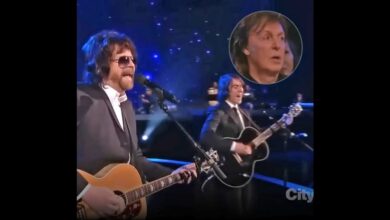
The guitars provide another relationship to follow. Acoustic sound can hold the pulse and harmony while an electric part adds a separate color, with neither needing to become an unrelated feature. Their roles support the voices, giving the duet continuity while leaving the melody’s small scale and gentle direction intact.
The ending returns to rest while the performance also makes continuation apparent through singing together. James and Henry Taylor need not change the song’s message for it to reach another generation. The recording preserves that pleasure in a specific Anaheim appearance, with its own closer distinct from the separate DTE concert recordings offered below as companions.
More performances to enjoy
Fire and Rain from the August 1, 2021 DTE recording offers another song in Taylor’s live repertoire. Its different narrative and occasion provide a companion for hearing his phrasing while keeping the performance separate from the Anaheim duet.
You’ve Got a Friend from the same DTE date offers another direct expression of comfort through song. It broadens the listening comparison beyond the father-and-son closer, providing related material within a different concert recording and musical setting.