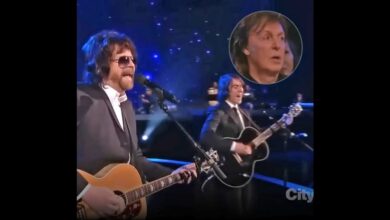
James and Henry Taylor Give “You Can Close Your Eyes” a Family Voice
At the Honda Center in Anaheim on October 30, 2021, James Taylor brought his son Henry into the closing performance of “You Can Close Your Eyes.” The song had first reached listeners in 1971. Sung together, its thought that another person can keep a song alive acquired a particularly immediate setting, with two generations sharing the same stage and familiar melody.
A final number helps determine what an audience carries away from a concert. This song is well suited to that purpose because it accepts the movement of time while offering a quiet form of reassurance. Day gives way to night, another day remains possible, and the singer makes room for someone to stay. The duet allows those modest promises to mark the show’s ending.
Henry’s participation places an older composition within a new encounter. The song has long been part of his father’s musical identity, but it is also something they can sing together now. Their relationship gives the lyric another perspective without requiring an explanation between phrases. The performance itself becomes the place where the song’s history and its present life meet.
“You Can Close Your Eyes” appeared on Taylor’s 1971 album Mud Slide Slim and the Blue Horizon. Its writing works at a small scale, finding feeling in a handful of direct assurances. The singer acknowledges limits while offering what he can. That balance keeps the music intimate and gives its words a warmth that does not depend on a dramatic declaration.
The melody’s openness makes it welcoming to another voice. Rather than requiring father and son to compete, it offers shared space in which the two can shape a familiar line together. James brings the association of the original singer, while Henry contributes to the song’s continuing life. Their duet makes that relationship audible through the act of performing.
Watch the performance
The opening movement from sunset toward moonlight establishes an everyday sense of change. It is an image of time continuing, with comfort found within that movement rather than outside it. As the closing song in Anaheim, the imagery fits the moment naturally. A concert is ending, and the lyric gives that departure a gentle musical shape.
The refrain offers rest instead of an answer to every difficulty. Its invitation to close one’s eyes creates a brief place of ease within the song. The restrained musical setting is part of that effect. Listeners are given space to follow the words closely, allowing the reassurance to remain personal rather than turning it into a larger statement than the lyric needs.
Hearing the line shared between two singers changes the feeling of the offer. Harmony can turn an individual assurance into something supported by another voice. The family relationship gives that musical fact an additional resonance here. The connection does not require a listener to imagine what the Taylors might say in private; it is present in their choice to inhabit the song together.
One of the lyric’s most affecting gestures is the singer settling on the song he is able to give. The thought is modest and conversational, yet it opens toward the possibility of someone else singing it in his absence. A small act of musical offering becomes something that can continue beyond the person who first presents it.
With Henry sharing the stage, that possibility becomes visible. The performance remains a father-and-son concert duet, while the lyric allows listeners to consider the passing of music between generations. The words need no extra emphasis to establish the connection. Another singer is already present, helping carry a composition that has been part of James Taylor’s repertoire for decades.
The song’s hopes for another day are similarly grounded. It leaves room for ordinary pleasure and the company of someone willing to remain nearby. Those possibilities give the reassurance its character. The writing does not reach for a sweeping promise; it finds emotional strength in offering a little time, a familiar melody and a place beside another person.
Taylor has other songs capable of producing a broad audience response, but this closer draws attention toward smaller interactions. Phrasing, harmony and the relationship between the voices become especially important. An established song is being sung with a grown son, and that circumstance can shift how a listener hears even the most familiar line without changing its wording.
The live setting also distinguishes the duet from a recording fixed at an earlier point in the song’s history. A composition can meet different performers and circumstances as their lives change. Anaheim captures one such meeting. Father and son give the familiar refrain a current context, allowing listeners to hear the song as an active exchange rather than a preserved memory.
Its direct images and welcoming melodic shape help make that possible. The song leaves room for another person to enter without needing an elaborate arrangement or a new dramatic premise. Henry can join the musical space already present in the writing. The openness of the composition makes its use as a shared closer feel natural to the occasion.
The guitars provide another part of the duet’s texture. James’s acoustic instrument and Henry’s electric playing bring different colors around the voices. Their contributions work best as part of the same intimate setting, supporting the pulse and harmony while leaving attention with the singers. The instrumental difference enriches the performance without turning it away from the lyric’s simple offer of comfort.
The last return to the refrain leaves an invitation to sing as well as an invitation to rest. James and Henry give the song another life by sharing it, allowing its message to extend beyond the voice that introduced it. The companion DTE recordings below provide other examples from Taylor’s repertoire, including “You’ve Got a Friend,” with its similarly direct language of reassurance.
More performances to enjoy
Hear Taylor’s “Fire and Rain” from the August 1, 2021, DTE performance in the recording shared by Shor’Line for another view of his live delivery.
The same DTE recording date also offers “You’ve Got a Friend,” shared by Shor’Line, a useful companion to the gentle assurances of “You Can Close Your Eyes.”