Adam Lambert’s ‘Who Wants to Live Forever’ Brings Queen’s Legacy to the Polar Music Prize
Queen was among the honorees at the Polar Music Prize in Stockholm on May 27, 2025, and Adam Lambert helped mark the occasion with “Who Wants to Live Forever.” The singer had spent more than a decade performing Queen’s catalogue alongside Brian May and Roger Taylor. Here, with the band being celebrated, he stepped into a different role: presenting one of its most emotionally demanding songs as a tribute.
The setting matters. This was an awards ceremony at the Grand Hôtel, rather than a stop on a Queen + Adam Lambert tour. May and Taylor were present to accept the prize on the band’s behalf, while Lambert performed for the gathering. The official recording places his voice and the song at the center of the moment, giving a familiar concert favorite a quieter, more ceremonial frame.
Written by Brian May, “Who Wants to Live Forever” appeared on Queen’s 1986 album A Kind of Magic and became closely associated with the film Highlander. Its long melodic lines and question about time and loss invite a singer to build feeling gradually. Freddie Mercury’s interpretation remains central to the song’s history, which gives any later performance both a point of reference and a challenge.
Lambert answers that challenge through his own phrasing. He begins with measured lines, allowing the melody room before moving toward larger sustained notes. The shift in intensity is part of the performance’s appeal: vocal range matters, but so does the control required to hold the opening back. His interpretation recognizes the song’s dramatic scale without turning it into an imitation of Mercury.
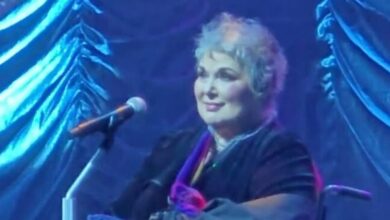
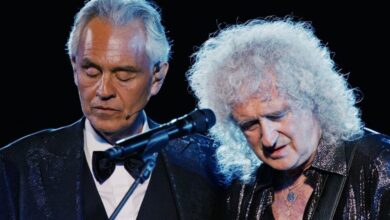
The supplied collage pairs close views of Lambert singing with images of May and Taylor applauding. Its fan caption praises his breath control and the reaction of the Queen musicians. Those words express a viewer’s admiration; the performance itself is the stronger evidence of his choices, from the softer entry to the forceful passages that follow. The image captures why the tribute has prompted such an enthusiastic response.
Lambert’s dark, sparkling stagewear adds a theatrical edge, yet the song remains the focus. He has often brought bold visual style to Queen’s music, and the award-night setting gives that style a different scale. Instead of a vast arena production, the camera returns to his face and the people listening. The result invites attention to a singer carrying a familiar melody through an occasion devoted to the band that made it famous.
The Polar Music Prize’s official video preserves the full arc of Lambert’s performance. Seen in sequence, the quieter phrases provide the foundation for the climactic lines. It also establishes the event’s real context: this was a tribute to Queen at the 2025 ceremony, with May and Taylor attending as honorees.
Another useful comparison comes from Queen + Adam Lambert’s 2016 Isle of Wight Festival appearance. Queen’s own retrospective highlights that rendition of the same song and its large-scale lighting. There, Lambert sang within a full festival show alongside May and Taylor. The Stockholm tribute uses a different setting to show how his approach to the ballad can work without the same touring spectacle.
Queen’s official account of the Isle of Wight performance records warm praise from both musicians for Lambert’s singing. Their remarks belong to that 2016 show, not the 2025 prize ceremony. Placed beside the newer tribute, they help explain a long-running musical partnership built around reinterpretation rather than copying an earlier frontman.
The song also has a remarkable live history before Lambert joined Queen. Footage from the band’s 1986 Budapest concert shows Freddie Mercury performing it during the Magic Tour. Hearing that recording beside Lambert’s versions makes the different settings clear: a stadium performance by the original band, a later festival show with Lambert, and finally an award-night tribute.
That sequence is what makes the Stockholm performance compelling. Queen’s music is being honored in front of its surviving members, and Lambert brings a voice shaped by years of singing those songs with them. His “Who Wants to Live Forever” works as a tribute because it lets the composition remain recognizable while allowing the singer’s own control, tone and stage presence to carry its emotion.