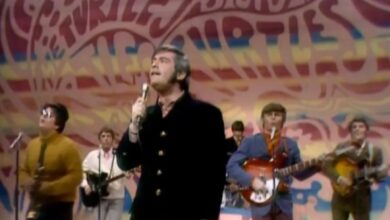
Ricky Nelson – Garden Party (1972): The Night That Changed Everything
In the early 1970s, Ricky Nelson stood at a turning point that few artists ever navigate comfortably. Once celebrated as one of America’s most beloved teen idols, he had grown far beyond the image that first made him famous. The polished, clean-cut television star had evolved into a musician deeply invested in the emerging country-rock movement. Yet while his artistry matured, a large portion of his audience remained emotionally tied to the past, expecting the same youthful hits that had once defined him.
That tension came to a head on October 15, 1971, when Nelson took the stage at Madison Square Garden in New York City. The event was a massive rock and roll revival concert, bringing together legends from an earlier era. It was designed as a nostalgic celebration, a kind of musical time capsule where audiences could relive the soundtracks of their youth. For many performers, it was an opportunity to reconnect with fans through familiar material.
But Nelson was no longer content to simply relive the past. When he walked onto the stage, everything about him signaled change. His longer hair, relaxed demeanor, and updated sound reflected the cultural and musical shifts of the early 1970s. He began with a few of his classic hits, briefly satisfying the audience’s expectations, but it was clear he had something else in mind—a desire to present who he had become rather than who he once was.
As the set progressed, Nelson introduced newer material and different stylistic interpretations. It was a bold move in a setting built entirely around nostalgia. The audience, primed for a specific version of him, began to react with confusion. That confusion quickly turned into something harsher. When Nelson performed a country-influenced number, the reaction shifted dramatically, and boos began to echo through the arena.
Whether those boos were truly directed at him or sparked by something else happening in the crowd remains a point of debate. But in that moment, standing under the bright lights of Madison Square Garden, Nelson felt the weight of rejection. To him, it wasn’t just noise—it was a message. It felt as though the audience was rejecting not just a song, but his entire artistic evolution.
The atmosphere grew tense. Nelson continued performing, but the connection between artist and audience had been broken. The energy that once defined his relationship with fans was replaced by uncertainty and discomfort. It was a stark reminder of how quickly admiration can turn when expectations are challenged.
Eventually, the experience became too much to ignore. Nelson left the stage before the concert’s finale, deeply affected by what had just happened. Backstage, there was confusion and conflicting interpretations of the night’s events. Some insisted the crowd’s reaction had little to do with him personally. But for Nelson, the emotional impact was undeniable. What he felt in that moment was real, regardless of the explanation.
In the days that followed, the incident stayed with him. It wasn’t just an embarrassing performance—it became something more profound. It forced him to confront the reality of his career and the complicated relationship between identity and public perception. He realized that audiences often hold onto an image, even when the artist has long since outgrown it.
Rather than retreating or trying to regain approval by returning to his old style, Nelson chose a different path. He channeled the experience into songwriting. Sitting down with a guitar, he began to process what had happened—not just as an event, but as an emotional turning point. That process would eventually give birth to “Garden Party.”
The song itself was layered with meaning. On the surface, it told the story of a strange and uncomfortable night. But beneath that narrative was a deeper reflection on fame, change, and self-acceptance. Nelson used metaphor and subtle references to paint a picture of an artist caught between two worlds—the past that defined him and the future he was trying to build.
One of the most powerful aspects of the song was its honesty. Nelson didn’t attempt to hide behind vague lyrics or disguise his feelings. Instead, he embraced the vulnerability of the moment. The now-famous line about not being able to please everyone captured a universal truth that extended far beyond the music industry.
When “Garden Party” was released in 1972, it resonated in a way few could have predicted. Audiences connected with its message, recognizing something deeply human in Nelson’s experience. The song climbed the charts and became one of the biggest hits of his later career, marking a remarkable comeback.
More importantly, it reshaped how people saw him. No longer just a nostalgic figure from an earlier era, Nelson was now recognized as a thoughtful and introspective songwriter. He had taken a moment of public discomfort and transformed it into something meaningful—something that spoke to listeners on a personal level.
The impact of “Garden Party” extended beyond Nelson’s own career. It reflected a broader cultural shift happening in the early 1970s, where artists were increasingly pushing against expectations and redefining their identities. The relationship between performers and audiences was evolving, becoming more complex and sometimes more fragile.
What made the story so compelling was its relatability. Even outside of music, the idea of being judged for changing, for growing, or for stepping outside expectations is something many people understand. Nelson’s experience became a kind of metaphor for that struggle—a reminder that growth often comes with resistance.
Looking back, the Madison Square Garden performance can be seen not as a failure, but as a turning point. It was a moment that forced Nelson to define himself on his own terms. Without that night, “Garden Party” might never have existed, and the depth of his artistry might never have been fully recognized.
In the end, what happened that night wasn’t just about a crowd’s reaction or a misunderstood performance. It was about transformation. Ricky Nelson took a moment of doubt and turned it into a lasting statement about identity, resilience, and artistic integrity. And in doing so, he created a song that continues to resonate long after the echoes of that night have faded.