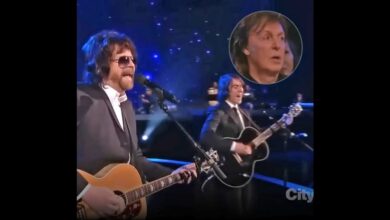
Tom Jones Sings Leonard Cohen’s ‘Tower of Song’ on The Voice UK
Tom Jones sings Leonard Cohen’s ‘Tower of Song’ from his coach’s chair on The Voice UK. The seated performance interrupts a program built around auditions and turns attention to the melody and words.
Cohen’s composition considers a musician’s life with wit, weariness and affection. Its reflective writing gives a seasoned performer room to communicate more than vocal force. The lyrics move between a worldly perspective and an acknowledgment of the demands of making music, which makes careful delivery especially useful.
Jones is known for a powerful voice, but this reading also relies on restraint. He lets the words remain close to the listener, allowing their meaning to carry the weight.
The other coaches’ responses help show the atmosphere in the room. The television set briefly becomes a place of attentive listening, and the camera captures that reception alongside the song.
The setting creates an appealing reversal: the judge becomes the performer. Jones demonstrates how an established voice can continue to find meaning in familiar material.
Watch the performance
‘Tower of Song’ does not need to accelerate constantly. Its measured pace gives tone and emphasis room to shape the story without requiring a succession of larger musical gestures.
Jones’s lower register provides a firm foundation. The sound contributes to the reflective mood, and the listener hears a particular voice addressing the lyric rather than simply reproducing a melody.
A mature performer can bring experience to a song about musical life without explaining a biography in an introduction. That connection is conveyed through the delivery itself.
Notice the pauses and the ends of phrases. Space around the words allows humor and seriousness to coexist; the same line can acknowledge difficulty and keep its wry character.
The contrast with the surrounding program contributes to the effect. Amid bright lights and competitive energy, a restrained song can invite a different kind of attention.
Cohen’s writing leaves room for the singer’s personality. Jones retains his recognizable vocal identity while respecting the composition’s thoughtful pace.
The coaches’ reactions are part of the scene, but they do not replace listening to the song. The recording remains worth hearing for its words, phrasing and carefully measured, consistent vocal delivery.
Economy can make small choices consequential. A direct line may communicate more than an elaborate run when the performance leaves enough space around the lyric.
The arrangement gives the voice a clear place. Its simplicity keeps attention on the connection between words and sound, supporting the song without crowding it.
The writing combines humor with reflection, and the singer need not explain an entire life story to express that mix. The weight of a phrase can become part of the meaning.
Watch the full performance to follow how Jones uses pacing. The pauses and restrained lines are not empty space; they help the song sound like a reflection offered in the moment. His position among the coaches makes the change of role visible, while the performance itself stays centered on Cohen’s song.
More videos to explore
The United States Air Force Band’s Singing Sergeants perform ‘Hallelujah’ in an a cappella arrangement. This companion offers a contrasting group interpretation of a familiar song.
Alexandra Burke performs ‘Hallelujah’ on The X Factor UK. Her live version offers another vocal approach to the composition in a separate television setting.
Jones’s performance and its companion recordings provide further listening context for Cohen’s song, including contrasting choral and solo interpretations that place a familiar melody in different musical surroundings: https://www.youtube.com/watch?v=cTWyaOg9K8I