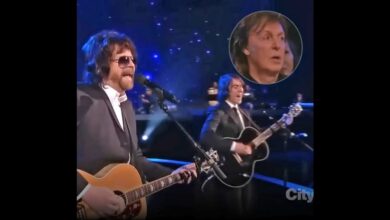
Adam Lambert Performs Queen’s ‘Who Wants to Live Forever’ at the Polar Music Prize
Adam Lambert performs ‘Who Wants to Live Forever’ during the Polar Music Prize tribute to Queen. The ballad gives the ceremony a musical center and lets his sustained lines carry a composition associated with the honored band.
The song calls for a different kind of intensity from a fast rock anthem. Its effect builds gradually, making patience and continuity as important as the most powerful notes.
Lambert gives the opening room to breathe. The measured start establishes a direction, and his individual voice keeps the tribute connected to Queen’s history while giving the melody a new color.
As the arrangement expands, his vocal line grows with it. The larger notes remain tied to the song’s melody, and the phrasing helps the progression stay clear.
That arc makes the appearance feel musical rather than merely ceremonial. The performance has its own beginning and development, with transitions linking the sections.
Watch the performance
‘Who Wants to Live Forever’ carries a reflective mood. Lambert’s interpretation respects that pace, using changes in tone and emphasis within a composition the audience can recognize.
He moves between restraint and force, making contrast part of the expression. The accompaniment grows around the voice while leaving the lead line distinct enough to carry the song.
The song’s association with Freddie Mercury gives the tribute a historical dimension. Lambert can honor that connection without copying every detail of Mercury’s performance; the two approaches can remain distinct.
Listen to the duration of the vocal phrases. Their sustained shape contributes to the music’s scale, while Brian May and Roger Taylor’s presence places the interpretation within the tribute’s wider context.
The ensemble supports the gradual expansion. Its contribution forms a frame around the lead, allowing the performance to develop through musical choices rather than relying only on the ceremony’s symbolism.
The prize event provides a public occasion to recognize Queen. Familiar music becomes part of that acknowledgment, and the melody gives the audience a way to follow Lambert’s personal delivery.
Lambert’s ‘Another One Bites the Dust’ from the same event offers a contrast. The two songs place different demands on rhythm, phrasing and the singer’s relationship with the backing.
The climax gains its effect from the restrained passages that come before it. The ceremony recognizes a body of work, while the performance offers a fresh encounter with one part of Queen’s repertoire.
Watch the complete rendition and notice how its intensity is distributed. Earlier measured lines prepare the fuller sections, making the closing arrival easier to understand. The arrangement does not begin at its maximum scale, and that gradual movement gives the later phrases room to register.
The two songs create different responsibilities for the same singer. A rhythm-led track asks for close contact with the pulse; this ballad gives sustained phrases more space to unfold.
Lambert’s Polar Music Prize appearance approaches Queen through a careful interpretation. His own voice gives the familiar ballad a present-tense expression shaped by sustained attention to the song.
More videos to explore
Queen performs ‘Who Wants to Live Forever’ live in Budapest. This recording provides another setting for the composition and a companion to Lambert’s tribute.
Adam Lambert sings ‘Another One Bites the Dust’ at the Polar Music Prize. The separate performance offers a more rhythm-focused comparison from the same event.
The tribute and companion recordings provide further context for Lambert’s performance, the song’s history with Queen and the different musical demands of the set: https://www.youtube.com/watch?v=rpj4RJscdV4