Christina Aguilera Revisits The Bodyguard’s Ballads in Her Whitney Houston AMAs Tribute
Christina Aguilera’s American Music Awards tribute returns to music associated with Whitney Houston and The Bodyguard. The film’s 25th anniversary supplies a clear occasion, while the songs give the acknowledgment a demanding musical form. Familiar emotional shapes meet another accomplished voice, allowing recognition and a present performance to occupy the same sequence.
The repertoire arrives with expectations already attached. Many listeners know these melodies through Houston’s delivery, giving the new rendition a direct reference before Aguilera adds her own phrasing. That familiarity can make differences of tone especially clear, allowing the audience to hear an interpretation within material whose history remains part of the encounter.
Aguilera keeps an individual vocal personality. The writing remains recognizable without requiring her to recreate every detail of an established recording, making the performance something sung now rather than only a reconstruction. Respect can come through attention to the songs’ demands while another tone gives their lines a different immediate sound.
The medley allows several kinds of expression to sit together. One section may ask for a close beginning, while another requires a longer, broader melodic line. Moving between those tasks gives the tribute variety, with the same singer supplying continuity as the composition and its emotional scale change around her.
Control matters throughout those changes. A familiar high point still needs a coherent phrase around it, giving its arrival a purpose beyond force alone. The performance’s musical interest includes the approach and release as well as the sustained note, keeping technique connected to the whole line instead of isolated from its setting.
Watch the performance
I Will Always Love You makes contrast particularly apparent. A restrained opening establishes a close frame before the song expands, allowing the later strength to sound like a development of the same idea. The quieter material has a role of its own, giving the arrangement more than one scale through which to communicate.
I Have Nothing carries intensity through another kind of melodic progression. Longer phrases need direction over time, allowing tension to remain active without turning every note into a separate event. The composition gives the singer a different task, broadening the tribute through the nature of the material rather than through a change of performer.
Aguilera’s voice connects those requirements. Listeners hear distinct songs while continuing to follow a recognizable lead, giving the transitions a common center. Her phrasing provides another form of continuity, helping the medley remain one performance even when a new melody asks for a different distribution of restraint and force.
Proportion is important within the short frame. Each selection needs enough room to establish its character while the sequence keeps moving, making the arrangement responsible for both recognition and direction. A familiar entrance can orient the audience quickly, but the section still needs a place in the larger tribute rather than functioning only as a brief reference.
The quieter phrases reveal how that larger direction is prepared. Hearing them alongside the climaxes makes the expansion easier to follow, giving a strong note an emotional setting. The audience can hear the change as it develops instead of encountering only the most conspicuous result separated from the line before it.
Houston’s presence in the tribute comes through the material’s associations. The songs can carry listeners’ memories while another singer offers an immediate interpretation, making the composition a meeting point between experiences. Those associations enrich the performance without requiring the new voice to disappear or every audience member to bring the same history.
Care in the delivery gives that acknowledgment a musical form. A sustained line needs continuity, and a soft phrase still requires enough definition to communicate the words. Those practical demands make attention audible, allowing respect for the material to be heard through what the performer does inside each song.
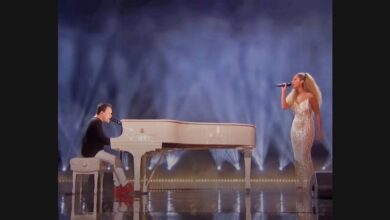
The awards ceremony adds a public frame to that listening. A large audience has a shared occasion for revisiting songs associated with a celebrated artist, while the featured singer carries the immediate work. The medley gives remembrance an activity, keeping its purpose connected to music rather than only to a statement about influence.
The full sequence shows how the sections relate. A handover can introduce another emotional shade while the vocal and instrumental frame keep the listener oriented, making transitions part of the interpretation. Watching only one highlight loses some of the design that allows the tribute to remain connected across changes of composition.
Different selections give the audience more than one route into the acknowledgment. A known opening establishes recognition, and the move onward changes what the singer must carry. Aguilera’s identifiable voice joins those tasks, letting each song contribute to a broader act of remembrance without making them interchangeable parts of the same melody.
The Bodyguard tribute keeps demanding music at the center of its purpose. Familiar compositions remain clear while another performer gives their changing requirements a present vocal shape. The recording rewards hearing that whole progression, with preparation, sustained phrasing, and transitions explaining the effect more fully than the largest moments alone.
More performances to enjoy
Houston’s I Will Always Love You at The Concert for a New South Africa supplies a direct concert reference. The official recording lets listeners hear the song through the voice being honored, providing another setting for its opening restraint and later expansion.
Aguilera’s Hurt at Wetten, dass..? offers a companion through her own repertoire. Its sustained line and changes of vocal scale provide another opportunity to follow the relationship between measured phrasing and a fuller sound, with a different song supplying the emotional frame.