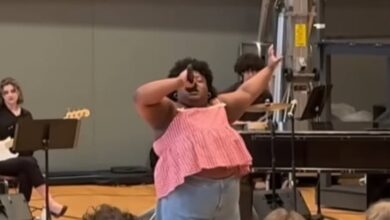
Erin Morton Gives Radiohead’s “Creep” a New Voice at Cincinnati’s Jam Band Event
At the University of Cincinnati College-Conservatory of Music’s annual Jam Band event, Erin Morton approached “Creep” as a song with room for another emotional perspective. Radiohead’s melody supplied immediate recognition, while her delivery changed the feeling around it. The performance connected with listeners far beyond the student audience, giving a familiar composition a distinctive voice within a live collegiate setting.
Morton was a musical-theatre student when the recording spread through social media in 2025. The attention brought a campus performance to an audience of millions, introducing both the vocalist and the students playing beside her. That origin remains part of its character. The recording captures a collaborative educational setting becoming a much wider opportunity for people to encounter the musicians’ work.
The interpretation develops through contrast. A song associated with an unsettled emotional atmosphere and a particular rock sound becomes the foundation for a vocal that can move between fragility and considerable force. The opening establishes the quieter scale first. When the intensity increases, the change feels connected to the musical journey the listeners have already followed rather than arriving without preparation.
Morton finds her own emphasis within the words instead of treating the original recording as a fixed vocal model. Pauses and restrained phrases give the early passages their exposed feeling; the fuller sections then alter the scale of the expression. The familiar melody holds those choices together. The identity of the song remains clear while its emotional weight shifts through a different approach to delivery.
The university credits Sarah Folsom and Jacob Priddy with the arranging and musical direction. Priddy also plays piano, joined by bassist Sophia Troyer, guitarist Micheal Dorst and drummer Aaron Coffenberry. Their contributions give the vocal a structure in which to develop. Hearing the performance as a collaboration makes the support around Morton more apparent alongside the voice that first attracted so much attention.
Watch the performance
The instruments establish a live foundation that can respond to the singer’s developing line. Momentum grows through the relationship between the parts, with accompaniment and vocal moving toward the same expressive destination. That responsiveness helps give the rendition its connected feeling. The musicians provide support and space at different moments, allowing the interpretation to expand without losing a sense of shared direction.
The recording also depends on work beyond the players. The school identifies fellow student Sydney Short as the person who captured the video, with Reagan Warvel supporting sound production. Those contributions enabled people outside the original room to hear the performance clearly. The encounter that later reached social media audiences began with students making both the music and the means of sharing it.
By April 2025, the university reported that the original TikTok recording had exceeded 11 million views. That figure marks the scale of the response at that point, giving the musical-theatre program an unexpected public moment. The recording’s continuing value is more directly available in the performance itself. New listeners can still follow the development that first encouraged others to share it.
The appeal is especially clear when the singer and band are heard together. The restrained passages leave space for the voice, and the arrangement opens around its greater intensity later on. The modest surroundings make that musical confidence easy to notice. Viewers encounter an emerging ensemble working through a committed interpretation, with the setting keeping attention close to what the performers contribute.
An effective cover can make a familiar line seem to belong, for a moment, to the person singing it now. Morton creates that possibility through emphasis and pacing. The words and melody are recognizable, yet a phrase can gain another weight through how it begins, pauses or resolves. Individuality emerges within the song’s existing form rather than requiring its identity to disappear.
The event also makes the value of shared creative work visible. Arranging, singing, instrumental playing and technical support all contribute to the result. The finished recording brings those responsibilities into one encounter, even when a first viewing concentrates mainly on the lead voice. Returning to the performance allows more of that surrounding work to become part of what the listener appreciates.
The university described new opportunities following the response, and Morton expressed gratitude for the encouragement she received. An online audience can introduce a young performer to people unlikely to have attended the original show. Here, the video provides that opening while keeping the intimacy of its beginnings. The performance reaches outward without losing the sense of students making music together.
Radiohead’s composition provides continuity through the changes in interpretation. Its familiar discomfort can be expressed through different instrumental and vocal choices, giving another performer room to reveal a particular emotional angle. Morton’s technique works most persuasively when it serves that purpose. The movement between restraint and intensity helps communicate the feeling of the song as a whole.
Hearing the complete recording explains more than a short climactic excerpt. The peak gains meaning from the softer material that leads toward it, and the ensemble’s pacing makes the connection audible. Listeners who arrive through a brief social clip have a reason to remain for the full performance. Its strongest moments belong within a larger shape developed by the musicians together.
The visual setting adds to that experience of discovery. Morton performs among fellow students, with the immediacy of a shared musical event around her. The audience’s later scale is not part of the original presentation; it follows the recording’s ability to communicate the work already taking place. The modest surroundings give the singing and playing an especially clear frame.
The cover rewards another listen because its individual parts remain worth following beyond the first surprise. Morton’s delivery brings the song its new perspective, while the accompaniment supports its pace and direction. What began as a school event becomes an introduction to an emerging group of musicians, with the full performance showing the shared decisions behind its widely heard emotional climax.
More performances to enjoy
The related guitaro5000 recording offers another discovery of an unexpected voice in a modest live setting, with musical exchange supplying its appeal.
Hear Radiohead perform “Creep” at Glastonbury in 2017 for a contrasting return to the band’s own live arrangement of the same song.