Jay & The Americans’ “Cara Mia” Becomes a Timeless Vocal Masterpiece That Still Stuns Generations
There are songs that arrive as hits, and then there are songs that arrive like events. Jay & The Americans’ “Cara Mia” belongs to the second category. Released in May 1965, it did not sound like the average pop single fighting for radio attention in the middle of the British Invasion. It sounded grander, stranger, and far more dramatic, almost as if a slice of old-world romanticism had suddenly crashed into American mid-sixties pop. That is still the thrill of hearing it now. The record does not simply begin; it announces itself, then keeps climbing until it feels as though the singer is trying to lift the roof off the room through sheer force of emotion and technique.
What makes “Cara Mia” so unforgettable is the scale of its ambition. Most pop hits of its moment were built for instant impact, compact hooks, and a youthful kind of swagger. “Cara Mia” had those qualities in spirit, but it wrapped them in something more theatrical. The arrangement swells rather than merely grooves. The melody aches rather than bounces. And the vocal does not flirt with intensity; it commits to it completely. The song feels almost operatic in how it rises, pauses, then surges again. That is why it has outlived so many more fashionable records from the same year. It was never just trying to be current. It was trying to be overwhelming, and in that sense it succeeded beautifully.
The story of the song stretches back before Jay & The Americans ever touched it. “Cara Mia” first emerged in the 1950s and had already proven it could connect with listeners in a very different musical climate. But the group’s 1965 recording gave it a second life by reframing it for a generation growing up on pop, rock, and vocal-group harmony. Instead of treating it as a museum piece or a novelty with European flair, they turned it into a fully committed emotional spectacle. That is the key difference. Their version does not wink at its melodrama. It embraces every ounce of it. Because of that, the song became a transatlantic survivor, moving from pre-rock romantic grandeur into the pop era without losing its dignity.
Much of the song’s power comes down to Jay Black, whose lead performance remains one of the most astonishing vocals ever captured on a mid-sixties pop record. There is a reason listeners still talk about the range, the control, and the almost impossible lift in his upper register. He sang “Cara Mia” less like a casual frontman and more like a man reaching for something just beyond the limits of ordinary pop expression. Yet for all the technical brilliance in the performance, it never feels cold. That is crucial. The notes are high and exacting, but the emotion inside them is even more important. The vocal sounds urgent, vulnerable, wounded, and proud at the same time, which is a very rare combination.
That emotional duality explains why “Cara Mia” became more than just a big vocal showcase. On paper, the song might seem almost too grand to work in a mainstream chart context. It is deeply romantic, unabashedly formal in its phrasing, and structurally more dramatic than many of its contemporaries. Yet listeners responded because the performance makes the emotion feel immediate rather than distant. The song is not simply ornamented with feeling; it is driven by it. Every phrase pushes toward some kind of release. Every sustained line sounds as if it carries real personal stakes. That quality has made the record feel timeless. It does not depend on trend, production gimmick, or contemporary slang. It depends on the oldest thing popular music has ever needed: conviction.
Commercially, the record had the kind of run that confirms it was not just an oddity admired from afar. Jay & The Americans’ version reached No. 4 on the Billboard Hot 100, hit No. 1 in Canada, and finished high enough on the year-end charts to prove it had genuine staying power during one of pop’s most competitive years. Those details matter because 1965 was not a sleepy period waiting for a dramatic ballad to arrive. It was one of the defining years in modern popular music. For a record like “Cara Mia” to cut through that environment says everything about how startling it must have sounded in real time. It was not merely successful; it was unmistakable.
What also keeps the song alive is the way it turns excess into elegance. Plenty of songs aim for grandeur and end up sounding bloated or theatrical in the wrong sense. “Cara Mia” avoids that trap because it has discipline underneath the drama. The arrangement rises in carefully measured waves. The backing never smothers the lead. The performance feels huge, but it also feels controlled. That balance is difficult to achieve, and it is one reason the song still sounds impressive instead of merely old-fashioned. There is a difference between being ornate and being overdone, and Jay & The Americans managed to stay on the right side of that line. The record knows exactly how far to push before it becomes too much, then pushes just a little further anyway.
Live performance is where the legend of “Cara Mia” becomes even more fascinating. A studio record can always be polished into shape, but songs with this level of vocal difficulty reveal their true stature onstage. That is why so many fans seek out live clips of Jay Black and later incarnations connected to the group. The central question is always the same: can that impossible feeling from the record actually be recreated in front of a crowd? The answer, remarkably often, is yes. And when it happens, the song stops feeling like a relic from another era and starts feeling immediate again. A good live “Cara Mia” does not inspire polite nostalgia. It creates astonishment, even among people who already know what is coming.
A modern fan-shot performance is especially revealing because it strips away the protective aura of old television lighting, vintage editing, and period mythology. In that environment, the song has to survive on pure musical impact. Hearing “Cara Mia” in a contemporary live setting underlines how unusual its architecture really is. It opens with a kind of poised romanticism, but there is tension coiled inside every phrase, and that tension keeps building until the whole performance feels like it is heading toward a cliff edge. The audience response in live clips often tells the story better than any review could. People are not just enjoying the song; they are waiting for the moment, that impossible leap, that burst of operatic power that turns admiration into disbelief.
The original studio version remains essential because it shows how carefully the drama was built from the ground up. Every production decision serves the song’s emotional arc. The orchestral sweep is not there merely to make the record sound lush; it acts like a stage set for the voice, widening the emotional horizon so the lead can hit harder when it finally rises. Even the pacing is crucial. The song understands suspense. It withholds just enough at the beginning to make the later explosion feel earned. That sense of narrative is one reason the studio cut still feels alive after all these years. It behaves less like a disposable single and more like a miniature musical drama compressed into radio length.
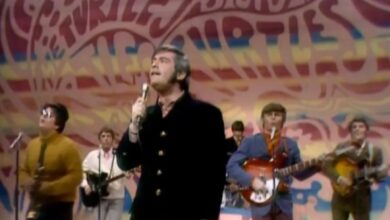
Television-era performance footage adds another layer to the song’s appeal because it shows how naturally the group’s image and delivery matched the material. Jay & The Americans had polish, but they did not come across as distant. There was a seriousness to the way they presented “Cara Mia,” and that seriousness was essential. A song this emotionally oversized can collapse if performed with irony or detachment. Instead, the band treated it as a genuine event. That sincerity still radiates from archival clips. The visual style may belong to another era, but the emotional commitment does not. Watching one of those vintage performances now, it becomes obvious why the song landed so hard in 1965. It looked and sounded like something bigger than routine pop entertainment.
The comparison clips from different periods also help explain why “Cara Mia” stands apart from so many other beloved oldies. A lot of sixties hits survive because of charm, rhythm, or cultural memory. “Cara Mia” survives because it still feels difficult. It still sounds like a challenge being met in real time. That matters in an age when audiences are used to hearing voices corrected, compressed, and polished into sameness. “Cara Mia” resists that kind of flattening. Its greatness depends on risk. The singer has to go for it. The band has to support that leap without losing balance. When a live version clicks, the song feels dangerous in the best way, as though it might fly apart from the pressure and somehow becomes magnificent instead.
Another reason the record endures is that it exists at a fascinating crossroads in popular music. It carries echoes of pre-rock vocal drama, old European romanticism, and formal ballad tradition, yet it also belongs to the age of youth radio, chart competition, and group branding. It is both antique and modern at once. That contradiction gives the song a strange freshness even now. It does not fit neatly into one lineage, which means it never gets trapped inside a single nostalgia box. Fans of vocal-group pop hear one kind of brilliance in it. Listeners drawn to theatrical ballads hear another. People who simply love overwhelming singers hear something almost athletic in the performance. The song keeps opening new doors depending on who is listening.
Jay Black’s reputation as a vocalist has only grown with time, largely because clips of “Cara Mia” continue to circulate among people encountering him for the first time. The usual reaction is some version of disbelief. How did a record this bold become a mainstream hit? How could someone sing it with that much force and still sound musical rather than merely loud? Those reactions are part of the song’s ongoing life. It is not preserved only by memory; it is revived by discovery. Each generation that stumbles onto “Cara Mia” seems to go through the same process: curiosity, surprise, then admiration. The song wins them over not because it asks for reverence, but because the performance leaves very little room to deny what it is.
There is also a wider historical reason to value “Cara Mia.” It reminds us that pop music has always been broader, weirder, and more adventurous than simplified histories often suggest. The sixties are sometimes reduced to a few dominant movements, but songs like this reveal a much richer landscape. There was room for garage grit, British beat, folk-rock reflection, girl-group sophistication, and also this kind of towering romantic spectacle. “Cara Mia” proves that audiences were willing to follow a song wherever it went if the performance was strong enough. That is an encouraging lesson, especially now. Popular taste has never been as narrow as gatekeepers like to pretend. A great record can still bend the frame around itself.
In the end, “Cara Mia” remains special because it combines technical astonishment with emotional sincerity in a way very few songs ever do. It is not simply a showcase for a huge voice, though it certainly is that. It is not merely an unusual old hit that survived the decade, though it did that too. It is a record that still produces a physical reaction when it reaches its peak. People tense up, smile, laugh in disbelief, or fall silent for a second after the big notes land. That kind of response cannot be manufactured by reputation alone. It has to be earned, again and again, every time the song plays. More than sixty years on, “Cara Mia” still earns it.